




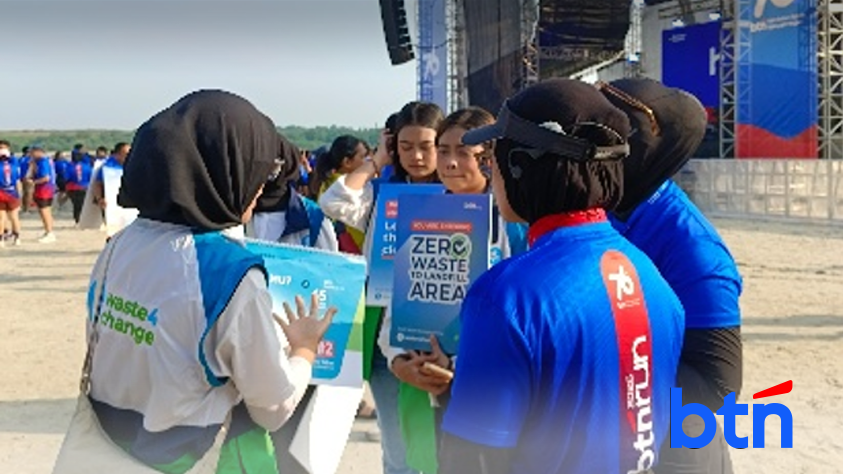
Proving that athletic endurance and environmental stewardship can stride hand in hand, the BTN Run for Charity 2026 took over BCIS Ancol, Jakarta, on March 29, 2026, with an ambitious mission that went far beyond the finish line. Beyond bringing together thousands of running enthusiasts, the flagship event successfully achieved a zero-waste-to-landfill milestone by managing every single piece of event-generated waste with absolute accountability. Partnering with waste management provider Waste4Change, BTN spearheaded an integrated strategy from on-site sorting to final processing, ensuring not a single scrap ended up suffocating local landfills. Out of the 1,460.2 kilograms—roughly 1.46 tons—of waste generated throughout the race, 100 percent was successfully diverted, recovered, and repurposed.
The race’s zero-waste victory was powered by a meticulous sorting and conversion system tailored to specific waste streams. Organic waste accounted for 511 kilograms, or 35 percent of the total volume, consisting primarily of leftover food and banana peels discarded by runners, which were transformed into high-quality compost and animal feed. Meanwhile, 603.2 kilograms (41.3 percent) of inorganic materials—including plastic bottles, paper, cardboard, and beverage cartons—were funneled directly to recycling partners to be repurposed into new materials. Even the remaining non-recyclable residue, weighing 346 kilograms (23.7 percent), was converted into Refuse-Derived Fuel (RDF) as an alternative energy source, guaranteeing that nothing went to waste.
This sustainable framework yielded a dramatic environmental dividend by significantly curbing the event’s carbon footprint. Compared to traditional waste disposal methods, the BTN Run For Charity 2026 successfully prevented 3,609 kilograms of CO₂ equivalent in greenhouse gas emissions from entering the atmosphere. To put that ecological impact into perspective, this reduction equals the carbon sequestered by planting 60 tree seedlings and growing them for a decade, powering 291,776 smartphone charges, or offsetting the emissions of a diesel vehicle traveling 31.6 kilometers.
At the heart of this green success was an active, community-driven effort championed by event volunteers, field educators, and the specialized Waste Runners team. Strategic waste infrastructure was deployed across the venue, featuring 10 multi-bin sorting stations throughout the Race Village and four additional stations positioned at Water Stations along the course. Field educators actively engaged runners with warm, interactive guidance on proper waste segregation, empowering participants to embody an eco-friendly lifestyle in real time. Through this remarkable feat, the BTN Run For Charity 2026 decisively proved that even small strides on the running track can spur giant leaps for the future of our planet.