




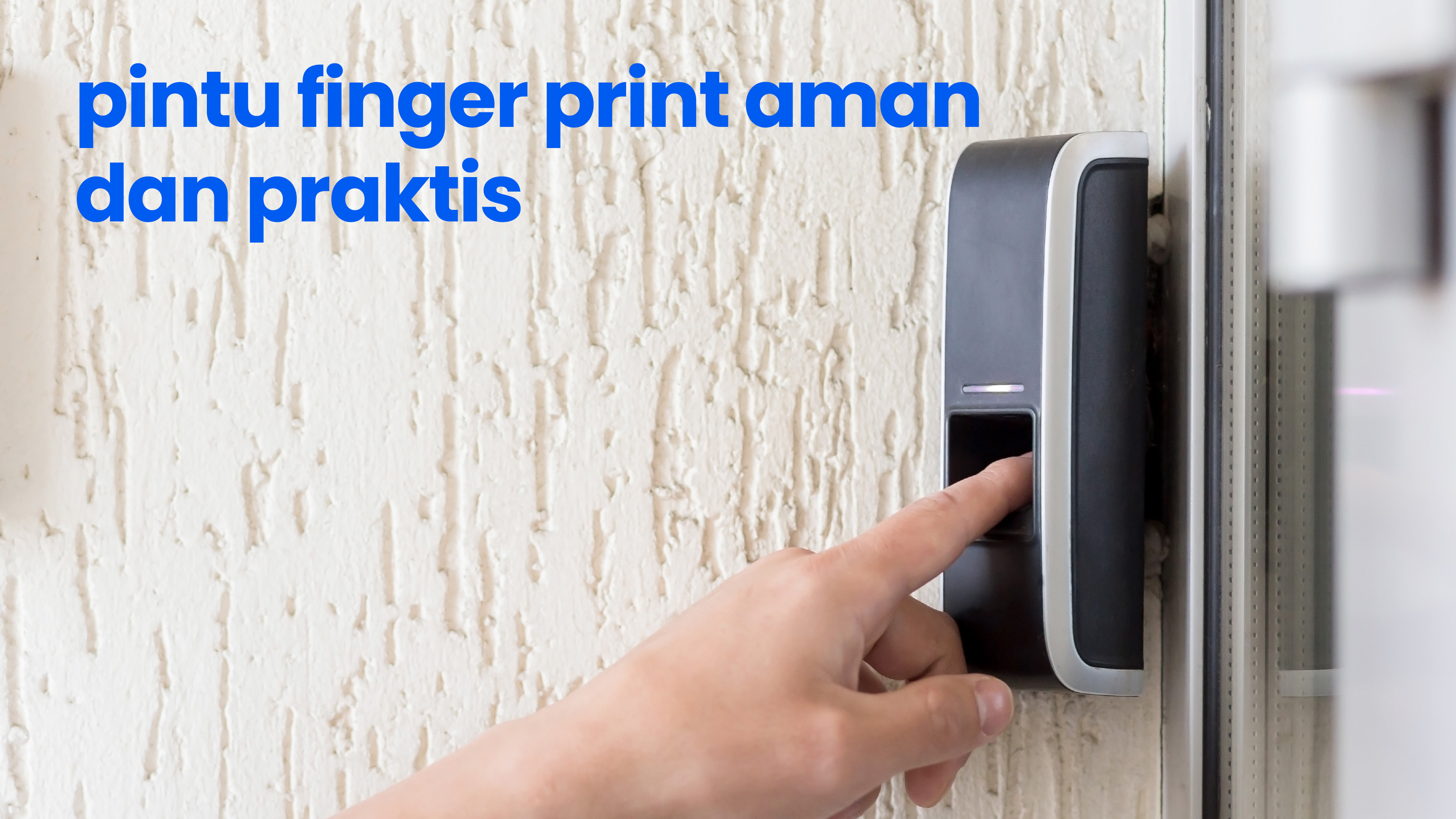
Security and comfort levels are the primary considerations in modern home design today. To understand how fingerprint doors have become a new standard, we first need to look at several important aspects. This system is no longer merely a replacement for conventional keys, it is a smart solution that integrates biometric security, access efficiency, and design aesthetics. With this technology, you can open a door with just the touch of a finger: practical, fast, and eliminating the risk of losing a key.
Key Takeaways:
- The working principle of fingerprint sensor technology and its integration
- Technical and design criteria for choosing a biometric door lock
- Challenges and solutions in implementation for modern homes
- How to ensure safe, efficient, and aesthetic installation
- Future trends in fingerprint doors within the housing industry
Understanding the Technology Behind Fingerprint Doors
At its core, a fingerprint door system is a combination of biometric technology, microcontrollers, and electromechanical lock mechanisms. In this system, biometric sensors play an important role in detecting and accurately identifying fingerprint patterns. Research from the Informatics Engineering Journal of UNIKA Santo Thomas (2021) explains that the foundation of this security system is the use of microcontrollers to process data from fingerprint sensors. The use of fingerprints offers a high level of security because every individual has a unique fingerprint pattern, making it far more difficult to counterfeit compared to physical keys or passwords. Fingerprint door systems have also become a superior solution in supporting modern home automation.
How Fingerprint Sensors Identify Users
Not all fingerprint sensors are created equal each technology has characteristics that affect the user experience. For home use, accuracy, speed, and reliability are the main factors. Understanding the differences between these sensor types helps us make a clearer and more informed product choice.
|
Sensor Type |
Working Principle |
Advantages |
Recommended Home Use |
|
Optical |
Captures a 2D image of the fingerprint |
Affordable, reasonably durable |
Interior doors with moderate security needs |
|
Capacitive |
Uses capacitors to map fingerprint ridges |
More secure, hard to fool, responsive |
Main door or private rooms requiring extra security |
|
Ultrasonic |
Uses sound waves to create a 3D fingerprint map |
High accuracy, can read wet or dirty fingers |
Areas that may be damp or require maximum security |
System Integration with Door Locks
The main advantage of a modern door lock system is its ability to integrate. Research published in ILTEK: Journal of Technology (2023) demonstrates the development of a door access control device that not only unlocks using a fingerprint but also sends online notifications through the Telegram app. System integration between fingerprint doors and other smart home devices is crucial for creating an interconnected and efficient smart home ecosystem. Such a system serves as a bridge between the physical door lock and the smart home ecosystem, allowing you to automate various scenarios such as turning on the porch light when the door is opened at night.
Data Security and Digital Protection Standards
Behind the convenience on offer, the security of biometric data is a crucial issue. The EPIC Journal (2023) highlights the importance of remote control of Internet of Things (IoT)-based devices. Your fingerprint data must not be stored as an image. Instead, it must be encrypted and stored in the form of a mathematical template. This encryption process ensures that biometric data is converted into a template that cannot be directly accessed by unauthorized parties, thereby enhancing security. For maximum privacy, storing data locally within the door lock device is often safer than cloud-based storage.
Criteria for Choosing a Fingerprint Door for a Modern Home
Choosing the right fingerprint door system involves more than just looking at its basic features. The decision must be based on material compatibility, technical specifications, and how well the design harmonizes with your home's style. It is also important to consider the security features offered by each fingerprint door system to ensure maximum protection for your home.
Material and Door Type Compatibility
For solid wood doors, a sturdy mortise lock body is required along with precise installation to avoid damaging the wood structure. Both classic and modern handle designs are widely available for this type. Aluminum or steel doors often have a slimmer profile, requiring a door lock with a more minimalist design and smaller mortise. Glass doors require a special lock installed using a clamp system without having to drill extensively into the glass.
Technical Specifications and Certifications
When it comes to durability, choose products designed for residential use with a high open-close cycle. For exterior doors exposed to weather conditions, an IP65 rating is the minimum standard to ensure the device is resistant to dust and water splashes. Most smart locks use batteries, so make sure there is a low battery indicator and an emergency power port feature (for example, via USB-C). Additionally, ensure that alternative access options are available, such as a password, RFID card, or mechanical key, in case the fingerprint sensor malfunctions.
Aesthetic and Architectural Design Factors
A fingerprint door must function as an integral part of the overall design. The sensor placement, handle design, and lock material finish must be in harmony with the architectural style of the home. For minimalist residences, handleless designs using a push-pull system are increasingly popular as they convey a clean and modern impression.
Implementing Fingerprint Doors in Modern Home Design
Successful implementation depends on careful planning. Integrating a fingerprint door is not just about installation it is also about creating an access flow that is easy and efficient for all residents. The use of an access control system is important to ensure that every resident can access the home with ease and safety.
Collaboration with Professionals
The most crucial stage of collaboration occurs during the design or renovation phase. Discuss sensor placement and door lock aesthetics with your architect or interior designer. Also involve an electrician to ensure that cable routing (if using an electrically powered lock) can be prepared in a concealed manner so that the installation looks neat.
Common Mistakes in Placement or System Selection
There are several common errors to be aware of. Placing the sensor too low or too high makes users uncomfortable when scanning. Overlooking door thickness is another frequent mistake, as not all smart locks are compatible with every door thickness always verify that the product specifications match your door. If using an electrically powered lock, an unstable power source can be problematic, so make sure the power supply is stable and includes a backup battery. Finally, installing an indoor-only lock on an exterior door will cause it to deteriorate quickly due to a lack of weather resistance.
Trends and the Future of Fingerprint Doors
Fingerprint door technology continues to evolve. Looking ahead, these systems will become increasingly intelligent and integrated, setting a new mandatory standard in modern residences. Furthermore, identity verification will become a central aspect of future fingerprint door technology development.
Integration with AI and IoT
Projections for 2025–2030 indicate that fingerprint door systems will become increasingly integrated with artificial intelligence. Future smart lock systems will be capable of learning the behavioral patterns of residents for example, detecting unusual access attempts and sending direct alerts to your phone. Within the broader IoT context, door access can trigger more complex smart home routines.
Design Implications and Property Value
Ultimately, fingerprint doors are no longer just a security tool they are also a marker of a modern property. Their presence directly enhances the perceived value of a home, signaling that the residence has been designed with a focus on efficiency, prestige, and advanced security. Investing in this smart security technology delivers higher resale value and a competitive edge in the property market.
Creating a Safe and Futuristic Home with Balé Community
With the implementation of fingerprint doors and integrated digital security systems, architects and developers can create residences and workspaces that are secure, intelligent, and high in value. From biometric access systems to smart door systems connected to IoT networks, everything is now available to support the design of future-oriented buildings centered on technology and comfort.
Beyond using a smart door system for security and convenience, effective communication of information whether from residential or building managers as well as easily accessible complaint services for all residents, are equally important. Balé Community is here to provide the solution. Visit Balé Community for more information.