




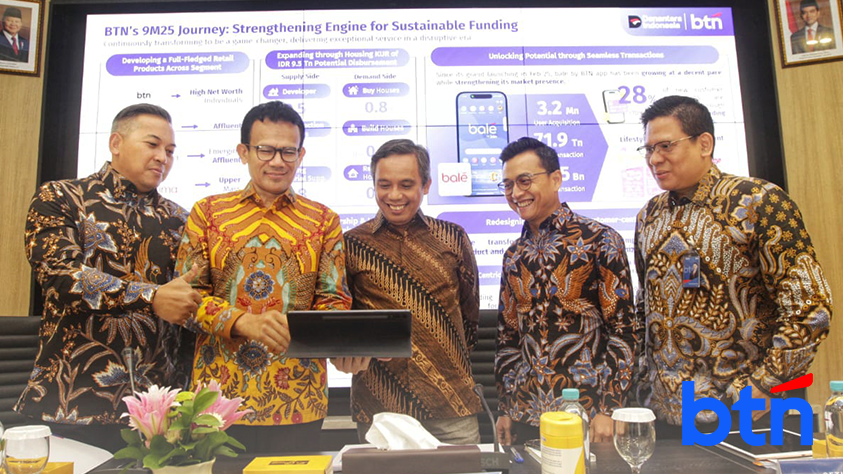
Jakarta, October 23, 2025 – PT Bank Tabungan Negara (Persero) Tbk (BTN) recorded outstanding performance during the January – September 2025 period, both in terms of net profit, loan disbursement, growth of third-party funds (DPK), and asset expansion. This achievement demonstrates that the transformation carried out by BTN has produced a positive impact on the company's business performance.
In the third quarter of 2025, BTN posted a net profit of Rp2.3 trillion, growing double-digit by 10.6% year-on-year (yoy) compared to Rp2.08 trillion in the same period last year.
BTN's net profit growth was driven by loan interest income which increased 18.8% yoy to Rp26.57 trillion by the end of September 2025, higher than the rise in interest expenses, which grew 2.5% yoy to Rp13.81 trillion. Interest expenses remained stable thanks to the company's efforts to increase the acquisition of low-cost third-party funds (DPK).
These efforts resulted in net interest income rising 43.5% yoy to Rp12.76 trillion by the end of the third quarter of 2025. Meanwhile, the net interest margin (NIM) increased 101 basis points (bps) to 3.9%, compared to 2.9% in the same period last year. Efficiency improvements also reduced the cost-to-income ratio (CIR) to 47.8%, down from 59.9% in the same period last year.
“BTN once again recorded net profit in the third quarter of 2025 thanks to our consistent efforts to maintain business growth, especially in housing sector financing and diverse financial transactions that benefit the overall economy. These efforts are supported by prudential principles and careful consideration of market needs,” said BTN President Director Nixon LP Napitupulu in a written statement in Jakarta, Thursday (23/10).
Nixon stated that BTN continues to gain public trust as a preferred bank for transactions, as reflected in third-party funds (DPK) growth of 16.0% yoy, reaching Rp429.92 trillion by the third quarter of 2025, compared to Rp370.75 trillion in the same period last year. BTN's DPK growth exceeded the banking industry's growth of 11.18% yoy as of the end of September 2025.
This DPK growth was supported by an increase in retail deposits, which have lower costs compared to large-scale institutional deposits. In addition, BTN continued to maintain the growth of low-cost funds (current account saving account/CASA), which accounted for nearly half of total DPK by the third quarter of 2025. This growth was also driven by increasing transactions through the balé by BTN application.
The number of balé by BTN users reached 3.2 million by the end of the third quarter of 2025, up 66.8% yoy from 1.9 million users in the same period last year. Meanwhile, the number of transactions surged 96.0% to 1.53 billion, compared to 783.5 million in the same period last year. The transaction value through balé by BTN reached Rp71.9 trillion by the end of September 2025, increasing 19.6% yoy from Rp60.1 trillion in September last year.
“The increase in users and transactions through the balé super app drives the growth of DPK balances at BTN. This shows that our digital initiatives continue to strengthen public trust in choosing BTN as their transaction bank. We hope this sustainable source of low-cost funds will become a new engine of strength for BTN as we move toward becoming a transactional bank in the future,” Nixon said.
Meanwhile, BTN's loans and financing continued to grow positively by 7.0% yoy, reaching Rp381.03 trillion by the third quarter of 2025, compared to Rp356.06 trillion in the same period last year. This growth was supported by housing sector loans and financing which increased 6.4% yoy to Rp322.53 trillion, as well as non-housing loans, which rose 10.7% yoy to Rp58.49 trillion.
In the housing sector, BTN recorded KPR Sejahtera FLPP (subsidized mortgage) disbursement reaching Rp186.58 trillion, growing 8.0% yoy compared to the same period last year. Meanwhile, non-subsidized mortgages grew 7.3% to Rp111.33 trillion, supported by BTN's strategy of partnering with top national developers and offering promotional mortgage interest rates.
“The government's decision to increase the Housing Financing Liquidity Facility (FLPP) quota to 350,000 units this year, with 220,000 units allocated to BTN, supports the growth of subsidized financing at BTN, in addition to various other incentives and stimulus measures. With government support and BTN's hard work, we hope more people will be able to own homes and improve their living standards,” Nixon explained.
With positive growth in funding and financing, BTN recorded a loan-to-deposit ratio (LDR) of 88.6%, compared to 96.0% in the same period last year, indicating adequate liquidity to support its intermediation function.
Meanwhile, BTN's total assets surpassed Rp500 trillion ahead of the end of 2025, reaching Rp510.85 trillion by September 2025, up 12.2% yoy from Rp455.10 trillion in the same period last year.
Sharia Business Unit Ready to Take Off as a New Islamic Bank
The growth of BTN's Sharia Business Unit (UUS) ahead of its transformation into a new Islamic bank continues to show strong performance in its core housing financing business and various sharia services.
By the third quarter of 2025, UUS BTN recorded net profit growth of 8.4% yoy to Rp592 billion, compared to Rp546 billion in the same period last year.
This achievement was supported by financing growth of 19.7% yoy to Rp51.10 trillion, compared to Rp42.70 trillion in the same period last year.
Meanwhile, third-party funds also grew double-digit by 19.3% yoy, reaching Rp56.90 trillion by the end of September 2025, compared to Rp47.68 trillion in the same period last year. Positive growth in financing and DPK drove asset growth of 18.4% yoy to Rp68.36 trillion, compared to Rp57.72 trillion in the same period of 2024.
“BTN's Sharia Business Unit is just one step away from becoming a Sharia Commercial Bank with enormous potential in Indonesia's Islamic banking industry. With the presence of Bank Syariah Nasional (BSN) as a new Islamic bank resulting from the spin-off, we believe more people will be served with sharia-compliant financial solutions for their various needs, contributing to the growth of the Islamic banking industry in Indonesia,” Nixon concluded.