




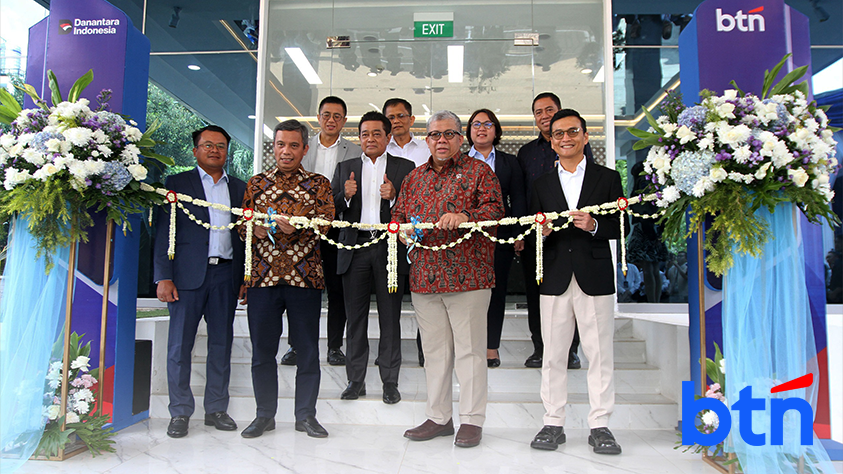
Bekasi, April 13, 2026 – PT Bank Tabungan Negara (Persero) Tbk (BTN) is strengthening its credit growth engine through the development of a Loan Factory, designed to accelerate processing, increase capacity, and maintain portfolio quality through more robust controls.
The initiative forms part of BTN’s ongoing transformation of its lending business processes, shifting from a branch-based decentralized model to an integrated, process-driven approach. This transformation enables credit disbursement to be executed more quickly, consistently, and at scale across the Bank’s network.
BTN President Director Nixon LP Napitupulu said the development of the Loan Factory is part of BTN’s transformation roadmap, which began in 2019 in response to the need to manage large-scale lending volumes under uniform standards.
“BTN receives around 1,000 mortgage applications every day. Relying solely on individual working methods would be risky. At this scale, processes must be standardized and operated under a common system,” Nixon said.
He added that standardization is key to ensuring consistent service quality and product delivery throughout Indonesia.
“If we want to become a large-scale institution, the processes must be the same. The requirements must be the same, the way we work must be the same, and the outcomes must also be consistent,” he emphasized.
Previously, BTN’s consumer lending processes were conducted in a decentralized manner at branch level before being enhanced through the establishment of Regional Loan Processing Centers (RLPCs) in 2019. The transformation has improved process quality and standardization while reducing potential deviations throughout the credit process.
Through the Loan Factory, BTN integrates all lending processes into a centralized, process-based model covering data input, verification, analysis, approval, and loan disbursement. This approach enables functional specialization at each stage, resulting in greater efficiency, accuracy, and consistency.
The Loan Factory also incorporates a decision engine within the credit scoring process to accelerate credit analysis and approval while strengthening process standardization, decision quality, and governance consistency.
As part of the implementation, BTN aims to shorten credit processing times from approximately six business days to a significantly faster turnaround, supported by enhanced process integration through the Loan Factory.
According to Nixon, the Loan Factory serves a strategic role not only as a driver of credit growth but also as a guardian of portfolio quality and a catalyst for operational efficiency through process standardization.
“Growth without quality is not acceptable. At the same time, quality without growth is also not enough,” he said.
From an operational perspective, BTN Operations Director I Nyoman Sugiri Yasa stated that the Loan Factory addresses inefficiencies that previously resulted from fragmented operating models.
“With the Loan Factory, processes that were previously dispersed and overlapping across different work units have become more structured and integrated. This makes operations more efficient, easier to monitor, and improves document governance and underwriting quality,” Nyoman said.
He added that process integration also strengthens the end-to-end credit service journey, from loan initiation to disbursement and document management.
Meanwhile, BTN Risk Management Director Setiyo Wibowo explained that the transformation represents part of BTN’s long-term effort to continuously improve lending processes in line with technological developments.
“From a decentralized process, to regionalization, and now to a centralized process-based model, we continue to enhance process quality through more consistent standards,” Setiyo said.
He added that the Loan Factory enables BTN to achieve economies of scale while strengthening process quality through a more structured and technology-driven approach.
“Through this approach, we are promoting processes that are more accurate, effective, and faster, while strengthening controls to minimize risk,” he explained.
In addition, BTN continues to enhance its digital capabilities through the adoption of technology, including the development of automation and artificial intelligence (AI) solutions for data input, verification, and credit analysis processes.
The Loan Factory transformation represents an important step in strengthening BTN’s operational foundation to support greater lending capacity nationwide, in line with the growing demand for housing finance.
“Our objective is clear: growth must increase, but quality must remain intact. That is what we are building through this Loan Factory,” Nixon concluded.